


Gold. For thousands of years, this precious metal has been considered one of the most valuable and beautiful materials in the world. To this day, it’s a sign of wealth and luxury that everyone wants to get their hands on.
But with this prestige comes a lot of imitation pieces that can be tricky to spot before buying gold. In this guide, we’ll be sharing tips on how to tell if your gold jewelry is real.
Some of the tests you can do on your jewelry are very accurate, and some may give false results – testing gold can be challenging!
Before Testing Gold At Home
There are a few things you should know about gold before you start testing it. First, know that there is no at home test that is 100% accurate. You will likely be able to get a good sense of if your gold is real, but for complete accuracy you will need to go to a jeweler. I do recommend cleaning your rings before testing them.
Second, different types of gold behave different. Plated, filled, hollow, and alloyed gold can give different results. Bullion gold will generally be only in bar or gold coin form and not made into jewelry or other items.
Gold Properties That Help Identify Real Gold
Given gold’s rich history, you’re probably thinking there must be a reason why it’s considered so precious and coveted, right? You’d be correct!
Of course, gold first and foremost has been prized for its beauty. Its rich warm yellow tone and natural shine are probably the first things that caught the eye of those who discovered it.
One thing that makes pure gold so useful is its malleability. Gold is easy to work with and can be pounded and drawn out an incredible amount. This flexibility in particular has made it a favorite for jewelry makers, metalsmiths, and other craftsmen. The softness of gold is what makes it leave gold marks when scratched.
On the more technical side of things, gold is also an excellent conductor of both heat and electricity. It is resistant to tarnish which makes it last longer than copper and silver. The lack of reactivity to different elements is what allows us to do different tests to determine if an item is pure gold or not.
Gold is a very dense metal which allows us to do floating tests.
How to Test Gold at Home (Basic Visual and No-Tool Tests)
Even since gold was discovered, it’s been a well-established symbol of wealth, status, beauty, and power. Unfortunately, like many fashionable status symbols, this means that gold is a prime target for forgery.
With these ten tests, you’ll be able to test your gold jewelry items for yourself and confirm whether your gold is real or imitation. Do not rely on the result of one singular at home test.
The first the tests are the easiest to do at home (without a testing kit!). I recommend doing all 3 of them together. They can help rule out obvious gold counterfeits but may be misleading on their own.

1. Stamp Test
One of the quickest ways to see if your gold is authentic is to look for an engraved hallmark somewhere on the jewelry. This stamp identifies your metal’s content and/or manufacturer. Check the insides of rings, the clasps of necklaces and bracelets, and near the posts of earrings.
The hallmark will be numbers that fall under either the Karat system (10K, 14K, 18K, 22K, 24K) or the Millesimal Fineness system(a 3-digit fineness number (e.g., 417, 585, 750, 916, 999). You can find lists of all the purity numbers you may find and if the numbers are anything other than these values, they’re likely fake.
Always look for a K. Carat (CT) is a measurement of the weight of gemstones and not an indication of pure gold
While this method of testing is not 100% foolproof this is a good starting point.
2. Letter Markings
The easiest way to see if your gold is fake is to see if it the stamps tell you it is! If you recognize the markings GP (gold plated), GF (gold filled), GE or GEP (gold electroplated), HGP or HGE (heavy gold electroplated) on your jewelry piece, the item is considered fake.
Gold-plated or gold-filled items are considered a fake item because they contain only a very small percentage of real gold. White gold and gold alloy also fall into this category.
3. Skin Discoloration Test
You’ve probably owned a piece of jewelry that, when worn for an extended period of time, leaves a blue, green, or purple tint on your skin. This is a sign of oxidation and a tell-tale sign of cheap and fake metal. Real gold won’t leave any discoloration on your skin.
A good way to test this is to hold your piece of gold jewelry in your bare hands for a few minutes. If the piece is real, you shouldn’t notice any color on your skin.
It’s worth noting that cosmetics, skin, and different body chemistry makeups can cause false results. Make sure to wash your hands before testing to try to get the most accurate result. This results of this test will likely support what you found in the first two tests. Skin discoloration is not accurate enough for it to be a deciding factor on its own.
4. Float Test
One easy test is the float test, also called the density test! Gold is an incredibly dense metal. In fact, one square foot of solid gold can weigh over half a ton! For this reason, real gold jewelry will rarely float.
Place your gold item in a cup of water and notice if it floats or sinks. If it floats, your item is almost certainly not real gold. Keep in mind that extremely lightweight or hollow gold jewelry may behave differently.
5. Magnet Test
This is a fast elimination test you can do at home! If you have a strong magnet handy, hold it up to your gold jewelry. Gold is not magnetic, so if you see any attraction, then the piece is not real gold.
Remember, there are other metals that aren’t magnetic either, so this test isn’t foolproof on its own.
6. Scratch Test
One of the most foolproof methods for testing your gold jewelry is the ceramic scratch test. For this method, get an unglazed ceramic plate or piece of tiles and scrape a piece of gold across the surface.
Real gold is extremely soft will leave a gold-colored marking, which other metals will just leave a black streak. You only have to do a very small scratch to complete this test!
Be careful to only scrape the tile enough to reveal a gold marking to avoid damaging your jewelry. If you believe your gold item is very valuable or is extremely sentimental, this is a test you may want to avoid.

7. Vinegar Test
For this simple test, all you’ll need are a few drops of vinegar. Find an inconspicuous location on your gold jewelry item and apply a bit of vinegar to the metal. Wait 5-10 minutes. Real gold will not react to the vinegar so you will not see any change. If your item has fake or plated gold, it may tarnish or turn green/black.
This test is safe for gold, but it may ruin non-gold items.
8. Nitric Acid Test
Gold is considered a noble metal, which means it is resistant to oxidation and corrosion from acids. This is why it shouldn’t change color when it comes into contact with your skin, vinegar, or nitric acid.
To perform the nitric acid test, rub your gold item on a black stone to leave a visible mark, then apply the nitric acid to the mark. Nitric acid will dissolve any base metals that aren’t gold, a real gold mark will remain.
I would avoid doing this test on high value or highly sentimental items.
Professional and Fail-Safe Tests
If you have done the at home tests and you are wanting confirmation that your item is gold, the following tests will provide the highest level of accuracy. I also recommend these testing options on valuable or sentimental items.
9. Gold Testing Machines
Thankfully, with today’s technology, determining whether your gold piece is real or not has become easier than ever. One example of this is a gold testing machine. These machines allow you to quickly identify whether your piece is genuine gold without potentially damaging your piece.
The two main types of machines for testing gold jewelry are an electronic tester and an XRF (X-ray fluorescence) spectrometer. These machines send either X-rays or electromagnetic waves through your gold piece and record and analyze how these different waves interact with the metal.
Using this information, the machine will tell you whether your piece is the real thing in a matter of seconds. The XRF spectrometer in particular is considered the fastest and most accurate of the tests. A handheld XRF analyzer can provide accuracy in the order of 0.1-0.01% for gold samples.
You can get a test done by a machine at specialized jewelry stores, reputable pawn shops, precious metal refineries, and specialized coin dealers.
10. Bring It To a Reputable Jeweler
While these home testing methods can be quick and easy ways to get an answer on whether your gold is real or not, there is still room for error. Some fake metals can pass these tests and look exactly like authentic gold. The best way and most reliable way of authenticating your gold is to take it to an experienced jeweler.
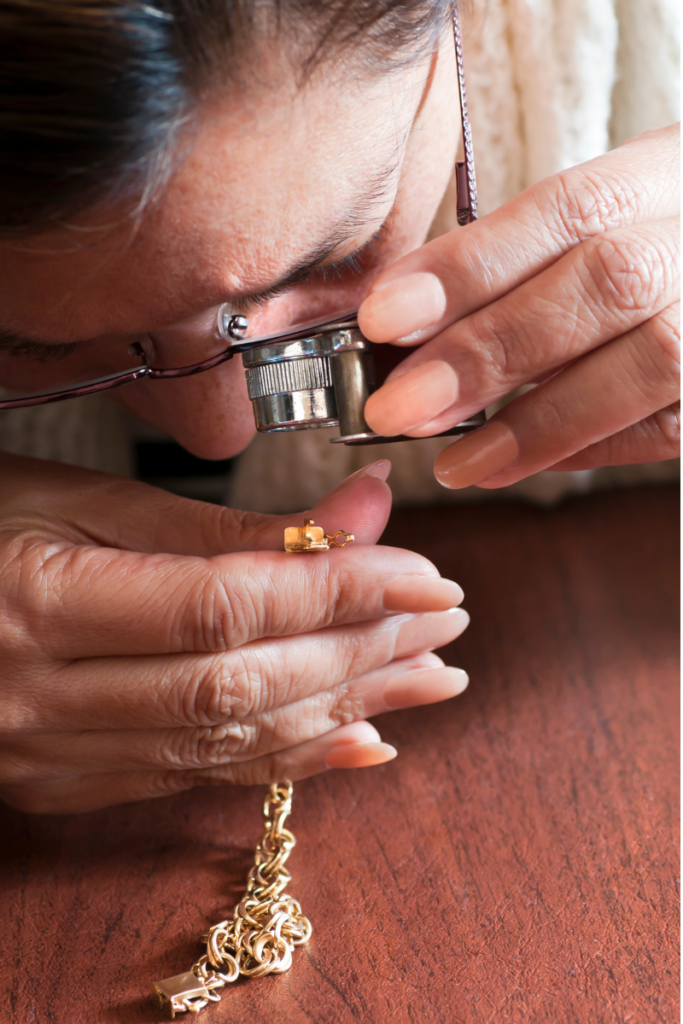
Reputable jewelers or jewelry stores will often have access to a wide array of testing methods that the average person does not. This combined with their many years of experience with creating and/or analyzing gold means that they can test the authenticity of your gold with ease. This can give you peace of mind that you know exactly what your item is made of.
The most experienced jewelers have likely handled many fake gold items and may even be able to tell you whether your piece is the real deal or not with just a look.
Jewelers will charge little to no money to test to see if your gold is real or fake. If you are wanting a full appraisal of your piece, they may charge up to $150. You can ask what the charge will be before committing!
If you are looking for ways to wear mixed metals, here are some of my favorite gold and silvery jewelry combinations.
Now that we know how to test for fake gold, let’s move on to designer bags! Here’s some tips for spotting a fake Gucci bag and also how to know if your Louis Vuitton is fake!